

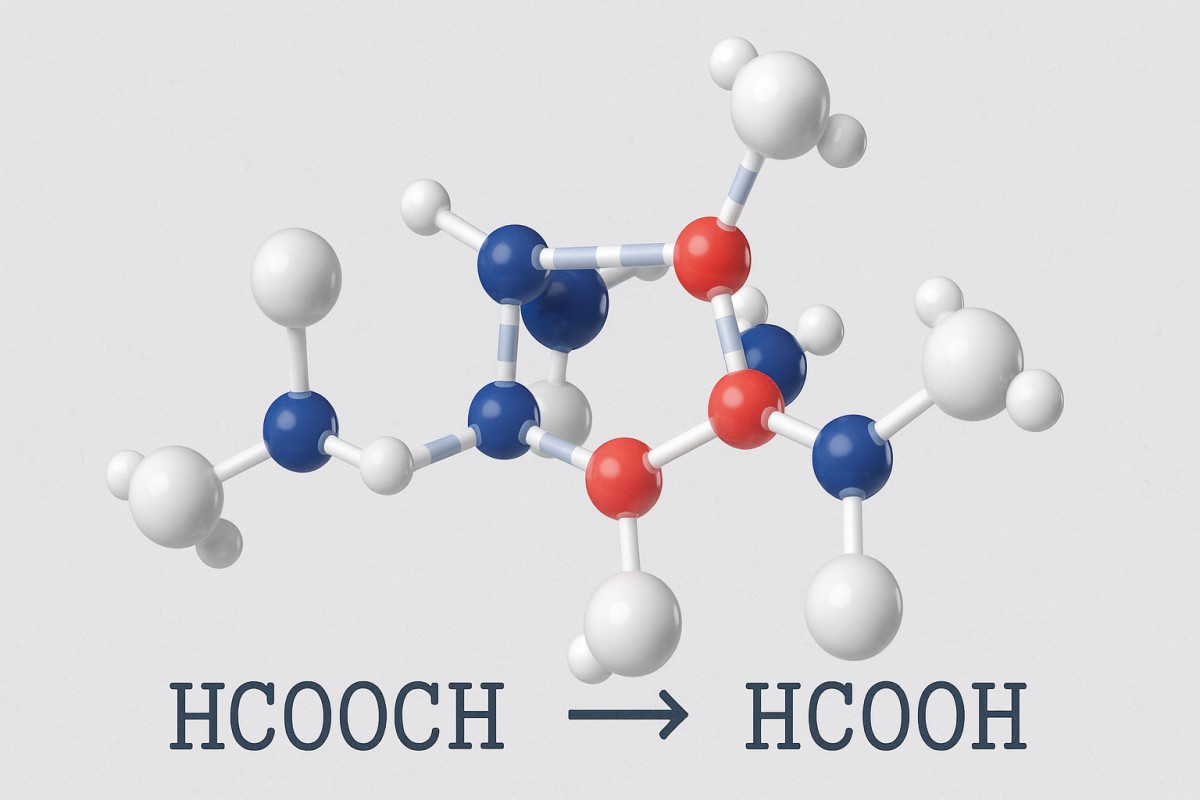
Organic chemistry often feels complex because of the symbols, formulas, and reactions involved. However, when broken down step by step, even reactions involving compounds like HCOOCH, CH₂, and H₂O become easier to understand. This article provides a basic organic chemistry explanation of these components, their roles, and how they interact at the molecular level.
Understanding the Chemical Components
HCOOCH (Formate Ester Group)
HCOOCH represents a formate ester functional group, commonly encountered in organic chemistry. They are widely studied due to their presence in:
- Organic synthesis
- Industrial chemistry
- Biochemical processes
Esters are known for their reactivity with water, especially in hydrolysis reactions.
CH₂ (Methylene Group)
The CH₂ group, also known as a methylene group, is a fundamental building block in organic molecules. It acts as:
- A carbon bridge between functional groups
- A contributor to molecular structure and stability
- An important unit in hydrocarbons and reaction intermediates
CH₂ groups play a key role in reaction mechanisms, influencing how molecules rearrange during chemical reactions.
H₂O (Water)
Water is one of the most important reactants in chemistry. In organic reactions, H₂O often functions as:
- A nucleophile
- A solvent
- A participant in hydrolysis and hydration reactions
Water’s polarity makes it especially effective in breaking ester bonds under suitable conditions.
The Role of H₂O in Organic Reactions
One of the most common reactions involving esters like HCOOCH is ester hydrolysis. In this process:
- Water attacks the ester bond
- The ester splits into a carboxylic acid and an alcohol
- The reaction may be acid-catalyzed or base-catalyzed
This type of reaction is fundamental in:
- Organic chemistry education
- Pharmaceutical synthesis
- Metabolic pathways in biochemistry
Reaction Mechanism Overview
When HCOOCH + CH₂ + H₂O are present in a reaction environment:
- Nucleophilic attack occurs as water interacts with the ester carbonyl carbon
- The CH₂ group helps stabilize intermediate structures
- Bond rearrangement takes place
- Final products form through proton transfer and bond cleavage
Understanding reaction mechanisms like this helps students grasp:
- Electron movement
- Functional group behavior
- Structure–reactivity relationships
Why This Reaction Matters in Organic Chemistry
Studying simple reactions involving HCOOCH, CH₂, and H₂O builds a strong foundation for:
- Learning esterification and hydrolysis
- Predicting organic reaction outcomes
- Understanding industrial and biological chemistry
These concepts are essential for anyone studying chemistry, biochemistry, pharmacy, or chemical engineering.
Conclusion
The reaction involving HCOOCH + CH₂ + H₂O may look intimidating at first glance, but it represents a core concept in organic chemistry. By understanding the functional groups, the role of water, and the basic reaction mechanism, students and beginners can develop confidence in analyzing organic reactions. Mastering these fundamentals opens the door to more advanced topics in chemical science.
Frequently Asked Questions (FAQs)
1. What does HCOOCH represent in organic chemistry?
HCOOCH represents a formate ester functional group. Esters are chemical molecules composed of a carboxylic acid and an alcohol. They are commonly involved in hydrolysis reactions, organic synthesis, and industrial chemistry applications.
2. What is the role of the CH₂ group in organic reactions?
The CH₂ (methylene) group acts as a structural unit that connects functional groups within an organic molecule. It helps influence molecular stability, reaction intermediates, and overall chemical behavior during organic reactions.
3. Why is H₂O important in organic chemistry reactions?
Water (H₂O) is crucial because it often acts as a nucleophile or solvent. In reactions involving esters like HCOOCH, water participates in ester hydrolysis, breaking chemical bonds and forming new compounds.
4. Is the HCOOCH + CH₂ + H₂O reaction an example of hydrolysis?
Yes, this reaction is commonly explained as an ester hydrolysis reaction, where water breaks the ester bond to produce a carboxylic acid and an alcohol under acidic or basic conditions.
5. What type of reaction mechanism is involved here?
The reaction follows a nucleophilic substitution mechanism, where water attacks the carbonyl carbon of the ester. This leads to the formation of reaction intermediates and eventually stable products.
6. Is this reaction important for students learning organic chemistry?
Absolutely. Reactions involving esters, methylene groups, and water are foundational topics in organic chemistry courses. They help students understand functional groups, electron movement, and reaction pathways.
7. Where are ester hydrolysis reactions used in real life?
Ester hydrolysis reactions are used in:
- Pharmaceutical drug synthesis
- Food and fragrance industries
- Biochemical processes in living organisms
- Industrial chemical manufacturing
8. Can this reaction occur without a catalyst?
While ester hydrolysis can occur naturally, it is usually slow without a catalyst. Acidic or basic catalysts significantly increase the reaction rate and are commonly used in laboratory and industrial processes.
9. What are the products of ester hydrolysis involving HCOOCH?
The products are typically a carboxylic acid (formic acid derivative) and an alcohol, depending on the molecular structure involved in the reaction.
10. How does this topic help in advanced chemistry studies?
Understanding reactions like HCOOCH + CH₂ + H₂O builds a strong foundation for advanced topics such as:
- Reaction kinetics
- Organic synthesis
- Biochemistry
- Medicinal chemistry