

It was one of those days when you feel a bit sad, a bit nostalgic, and even a little lost. I sat in the middle of the empty living room, between the packing boxes that were holding my life, and a question came to me: how many times have I stood at the same crossroads? How many times have I embraced change and taken a leap of faith into the unknown?
I have moved homes, jobs, locations, friendships, ideas, and expectations around 42 times in 50 years. For those familiar with the brilliant work of Douglas Adams, the number leads straight to Life, the Universe and Everything, where the ultimate answer to the meaning of everything is 42.
But I had no answers, and even fewer good questions about what healing after life changes truly looks like.
But why? Does it mean change is something I embrace fearlessly? In my personal life, did I try to outsmart life by running away from it? To leave before being left? Is it the trauma talking, or a deep understanding of the unpredictability and eternal cycle of life, with its own magic always elusive to us all?
Life changes sometimes come like a dark cloud or a scream in an obscure corridor, but sometimes they arrive like pink cherry blossom, full of potential, future hopes, and quiet desires.
As Charles Darwin’s theory of evolution, specifically natural selection, suggests, the most successful individuals are not necessarily the strongest or most intelligent, but those most
adaptable to change. This principle, often called “survival of the fittest,” reminds us that those who embrace change rather than resist it are the ones who continue to evolve.
Sitting there among the boxes, I realised that change is part of healing, and healing means accepting change – in other words, accepting life as it comes.
How do we cope with life changes? How do we trust new colleagues, new places, and new people? What happens to our understanding of life if we suddenly go through a divorce or are made redundant?
It can feel as though the world no longer needs us. Our everyday mirrors – the simple but affirming routines that once reflected who we were – are gone. Our sense of value can feel
diminished, and suddenly, we are left alone and unwanted. The inner child begins to suffer. Memories long forgotten since childhood are quickly summoned into the present moment, and we find ourselves back on the playground or at a school party, where everybody seems to fit except us.
And the choice becomes this: am I a victim, or am I simply a person undergoing the same obstacles everybody else experiences but rarely admits to?
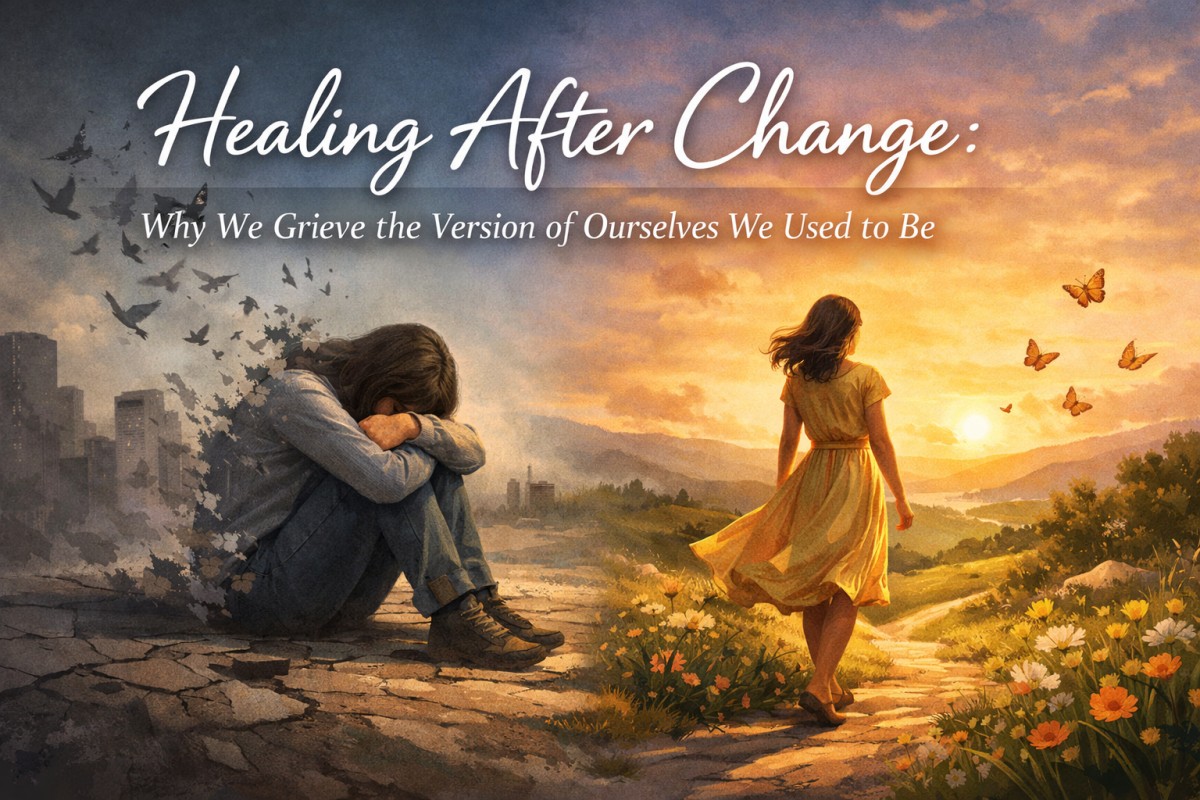
Healing after change is not about returning to who we were, but learning how to become whole in a new form.
Changes are bridges between one reality – the past status quo – and a new field of unexplored opportunity, a new Hero’s Journey. As we leave one world behind, we leave friendships, rituals of the city we know, the familiar Sunday coffee meetings with friends, or even the smell of a loved one.
We have built a life. We have invested ourselves, our hearts, our time, and our hope for the future. So the end of a life cycle is a trauma; it is a parting with a facet of our own personality. It is like finishing a book with characters we love and have become deeply invested in, only to realise it is the last page and we must now return to the reality of our ordinary lives.
We grieve our old version before moving toward the new self. Each new version of ourselves asks for a new becoming, and the old self needs to remain in the past. We part with a part of ourselves.
Healing is the way we love ourselves. It is the way we choose to treat ourselves and the way the new chapter of our lives will begin to feel.
Change is the space of discomfort, darkness, and confusion, with the only guiding light coming from our internal source of faith in the unknown. Faith that we can do better this time. Faith that we will be kinder this time. Faith in the goodwill of the cosmic clock that measures the next step of our evolutionary journey toward ourselves.
Life changes, in many cases, find us deeply unprepared and unwilling to make the leap. They come to unroot our internal tree of identity and confidence. We feel as though we have lost our energy, our sense of belonging. We are challenged by this invisible force, hiding in the face of a boss, a cheating partner, or an abusive relative. But behind it all is a call to a new life and a new adventure, because the old has already played its part and no longer feeds us.
This is the time to take charge and realise that the landscape may change, but the main character is still you.
And you are the one who creates the internal space of peace or chaos. This is the time to prioritise the inventory of your feelings and thoughts.
Check author’s work: Art | Zanara Art | England
Creativity is the key to healing.
People often think one needs to be an artist, but creativity expresses itself through many forms and triggers.
Even in the midst of change, if you have never journaled or drawn before, it may feel like yet another unfamiliar activity in your life. But consider this time and effort well spent, dedicated to your inner dialogue – an exploration of what is happening deep inside you, your true response to what is unfolding on the surface.
Healing after change begins in the smallest acts of returning to ourselves.
A notebook opened in silence.
A walk in a new street that still feels unfamiliar.
A cup of coffee held with both hands while we allow ourselves to feel what was lost instead of rushing to replace it.
Sometimes healing is not action, but permission.
Permission to mourn the life that ended.
Permission to miss the people who no longer walk beside us.
Permission to admit that even the right changes can still break our hearts.
We often celebrate beginnings, but few people speak honestly about the grief hidden inside transformation. Every new chapter asks for a form of death: the death of certainty, identity, routine, and the version of ourselves that once knew exactly where home was.
This is why healing must become a way of living rather than a temporary response to pain. Healing is how we build trust with life again.
It is found in rituals, in writing, in creativity, in nature, and in conversations that allow the inner child to finally be heard. It is the courage to sit with discomfort long enough for it to reveal its message.
Because every life change, no matter how painful, carries within it a secret invitation: not to become someone else, but to become more deeply ourselves.
Perhaps this is the hidden gift of change.
It removes what no longer belongs so that the essential self can emerge. The house may change.
The city may change.
The people may change.
But the soul keeps gathering wisdom through every ending. And maybe healing is not about fixing what was broken.
Maybe healing is learning to bless every version of ourselves that got us here, and then gently walking forward with the one who is ready to be born next.
Author
ZANARA is a UK-based Bulgarian writer, artist, and narrative therapist whose work explores transformation, identity, healing, and the symbolic language of life transitions.