

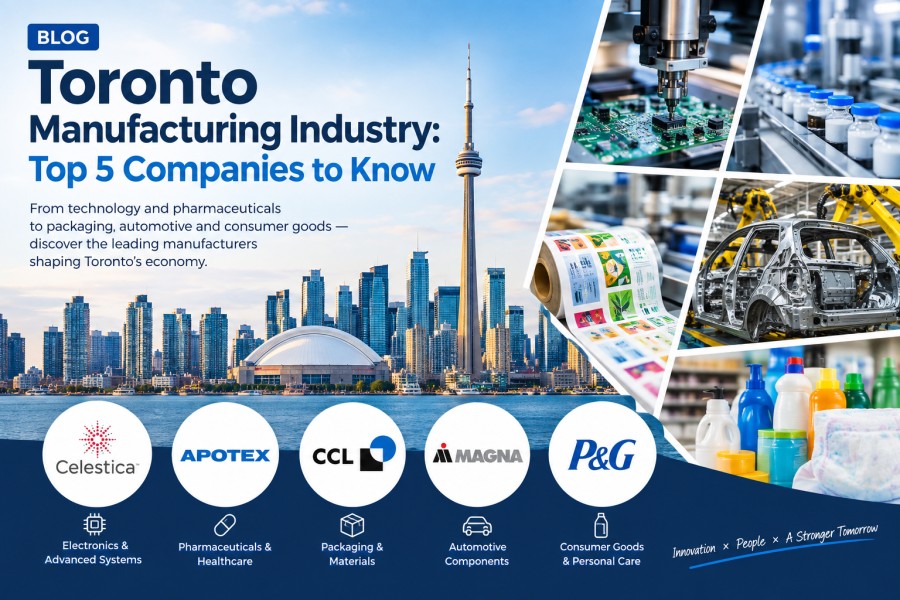
Toronto is widely recognized for finance, technology, real estate, healthcare, and professional services, but manufacturing remains an important part of the city’s economic landscape. The modern Toronto manufacturing industry is far more diverse than traditional factories might suggest. It includes pharmaceuticals, electronics, automotive components, packaging, consumer products, food production, aerospace, advanced engineering, and technology-enabled manufacturing.
The city and its surrounding Greater Toronto Area provide manufacturers with access to transportation networks, skilled workers, research institutions, suppliers, customers, and international markets. Toronto’s location within Ontario also gives companies access to one of Canada’s largest industrial ecosystems.
According to the City of Toronto’s 2025 Employment Survey, manufacturing remained the largest source of jobs within Toronto’s Areas of Employment, accounting for 76,450 jobs. Those employment areas contained 412,100 jobs and 22,530 establishments overall, demonstrating the continued importance of employment and industrial districts to Toronto’s economy.
At the same time, the meaning of manufacturing has changed. Modern manufacturers increasingly combine physical production with engineering, automation, software, research and development, supply chain management, quality control, and data-driven operations.
This article explores five companies that help illustrate the breadth of the Toronto manufacturing industry:
- Celestica
- Apotex
- CCL Industries
- Magna International
- Procter & Gamble
These companies operate in different industries and use different manufacturing models. Together, they provide a useful picture of how manufacturing in Toronto and the surrounding region has developed into a highly specialized and globally connected sector.
Understanding the Toronto Manufacturing Industry
Before looking at individual companies, it is useful to understand what makes manufacturing in Toronto different from the traditional image of an industrial city.
Manufacturing today involves much more than assembling products on a production line. A modern manufacturing company may design a product, source components from several countries, manufacture or assemble parts, test finished products, manage inventory, package goods, and distribute them to customers around the world.
Toronto’s manufacturing ecosystem includes companies working in:
- Automotive manufacturing
- Electronics manufacturing
- Pharmaceutical manufacturing
- Medical and healthcare products
- Specialty packaging
- Consumer goods
- Food manufacturing
- Aerospace and defense
- Industrial equipment
- Advanced materials
- Plastics and chemicals
- Product design and engineering
- Supply chain and logistics
The Toronto region is particularly important because it connects manufacturing companies with a large consumer market and an extensive network of suppliers.
The surrounding municipalities—including Mississauga, Brampton, Vaughan, Markham, Richmond Hill, Aurora, and other communities—form part of the wider industrial network that businesses often associate with the GTA.
This is why a search for manufacturing companies in Toronto can produce companies whose major facilities are technically outside the City of Toronto but remain closely connected to the region’s manufacturing economy.
1. Celestica
Celestica is one of the most recognizable technology-focused manufacturers associated with Toronto.
The company is headquartered in Toronto and provides design, engineering, manufacturing, supply chain, and after-market services to customers across several industries.
According to Celestica, its Toronto operation has expertise in engineering, commercialization, supply chain, complex system manufacturing, and after-market services. Its Toronto location serves customers in areas including healthcare, smart energy, aerospace and defense, and industrial markets.
Celestica reported 2025 revenue of US$12.39 billion, more than 33,000 employees worldwide, and more than 45 manufacturing and design centers globally.
What Does Celestica Manufacture?
Celestica operates in a specialized area of manufacturing often referred to as electronics manufacturing services and design manufacturing.
Its capabilities extend beyond simply putting electronic components together.
The company describes services including:
- Product design and development
- Engineering services
- New product introduction
- Component sourcing
- Electronics manufacturing
- Assembly and testing
- Complex mechanical assembly
- Systems integration
- Precision machining
- Order fulfillment
- Logistics
- After-market repair
- IT asset management and disposition
This combination demonstrates how manufacturing has become increasingly integrated with engineering and supply chain services.
Why Celestica Matters to Toronto Manufacturing
Celestica represents the technology side of Toronto’s manufacturing industry.
Traditional manufacturing is often associated with physical materials such as steel, plastics, chemicals, or automotive components. Electronics manufacturing adds another layer: precision engineering, component management, software-related systems, testing, and complex assembly.
This makes Celestica particularly relevant to the growth of advanced manufacturing.
The company’s Toronto headquarters also highlights an important feature of the region. A manufacturing company does not necessarily need its corporate headquarters and every production facility in the same location.
Instead, companies can operate an international network where corporate management, engineering, manufacturing, supply chain operations, and customer support are distributed across multiple regions.
Celestica’s global network follows this model.
Industries Served by Celestica
Celestica works across multiple markets rather than depending on one manufacturing category.
Its operations include technology and products associated with:
- Aerospace and defense
- Healthcare
- Industrial equipment
- Smart energy
- Communications
- Enterprise technology
- Capital equipment
This diversity can be important for manufacturing companies because demand does not always move in the same direction across industries.
A company supplying several sectors can use its engineering and manufacturing capabilities across different customer requirements.
Toronto’s Role in Advanced Electronics Manufacturing
Celestica also illustrates how Toronto has moved toward advanced and knowledge-intensive manufacturing. Modern electronics manufacturing requires specialized workers, engineers, quality specialists, supply chain professionals, and technical managers. It also requires sophisticated facilities and close coordination between design and production.
For Toronto, this creates an intersection between technology and manufacturing. Rather than treating manufacturing and technology as completely separate industries, companies such as Celestica demonstrate how the two can operate together.
2. Apotex
Apotex represents another major part of the Toronto manufacturing industry: pharmaceuticals.
Apotex is headquartered in Toronto and operates manufacturing facilities across Ontario. The company describes itself as a Canadian-based global pharmaceutical and healthcare company, with operations covering generic medicines, biosimilars, branded products, consumer health products, and active pharmaceutical ingredients.
Its global headquarters is located at 150 Signet Drive in Toronto.
Apotex currently identifies five Canadian sites, including its Toronto headquarters, with capabilities covering pharmaceutical manufacturing, packaging, warehousing, distribution, and active pharmaceutical ingredient production.
Pharmaceutical Manufacturing in Toronto
Pharmaceutical manufacturing is significantly different from conventional industrial manufacturing.
The process requires strict quality systems, controlled environments, testing, documentation, regulatory compliance, specialized equipment, and carefully managed supply chains.
A pharmaceutical manufacturer may need to manage everything from raw materials and active pharmaceutical ingredients to formulation, production, packaging, quality testing, and distribution.
Apotex operates across several parts of this value chain.
Its Canadian manufacturing capabilities include:
- Oral solid dose manufacturing
- Liquid manufacturing
- High-potency manufacturing
- Active pharmaceutical ingredient manufacturing
- Packaging
- Warehousing
- Distribution
The company says its Canadian operations include high-capacity facilities producing tablets and capsules as well as specialized liquid and high-potency manufacturing infrastructure.
From Toronto to Global Markets
One of the interesting characteristics of Apotex is the relationship between local manufacturing and international distribution. A company can have a Toronto headquarters while manufacturing and distributing products through a wider network.
Apotex says its products reach approximately 70 countries and that its global manufacturing footprint includes facilities in Canada, Mexico, and India. This international reach demonstrates the importance of Toronto as a location for corporate management, research, pharmaceutical expertise, and supply chain coordination.
Innovation in Pharmaceutical Manufacturing
Pharmaceutical manufacturing is increasingly influenced by automation and process optimization. Manufacturers need to improve production efficiency while maintaining strict quality requirements. For pharmaceutical companies, a faster manufacturing process is not useful if it compromises quality. As a result, production systems must balance efficiency with precision, safety, traceability, and compliance.
Apotex describes investments in automation, packaging, logistics, and continuous improvement across its Canadian manufacturing operations. This is representative of the direction in which modern manufacturing is moving. Automation does not simply mean replacing workers with machines. In many advanced facilities, automation is used to improve consistency, monitor production, reduce repetitive tasks, collect data, and support quality control.
The Importance of Pharmaceutical Manufacturing
Pharmaceutical manufacturing also shows why the Toronto manufacturing industry cannot be measured only by traditional industrial output. Medicines require advanced research, highly controlled production, sophisticated testing, and reliable distribution. The sector creates demand for:
- Scientists
- Engineers
- Production specialists
- Quality assurance professionals
- Regulatory specialists
- Supply chain managers
- Packaging specialists
- Maintenance technicians
- Data and technology professionals
This creates a broad employment ecosystem around manufacturing.
3. CCL Industries
CCL Industries is another Toronto-based company that demonstrates the diversity of the local manufacturing sector. CCL Industries has corporate offices in Toronto and operates a large international production network.
The company was established in 1951 and currently reports approximately 26,000 employees and 214 production facilities in 42 countries. Its 2025 annual revenue was approximately C$7.7 billion. Its Toronto corporate office is located at 111 Gordon Baker Road.
What Does CCL Industries Manufacture?
CCL is particularly associated with labels, specialty packaging, films, and related converted materials. Its operations cover several product categories, including:
- Pressure-sensitive labels
- Specialty films
- Packaging materials
- Aluminum aerosols
- Specialty bottles
- Tubes
- Instructional leaflets
- Decorative components
- Security products
- Electronic displays
- RFID and retail technology products
The company’s operations serve industries including consumer packaging, healthcare, chemicals, electronics, automotive, and other markets.
Manufacturing and Packaging
Packaging is sometimes overlooked when discussing manufacturing. However, packaging is a major part of modern production.
A product cannot simply be manufactured and placed directly into a warehouse. It often needs protective packaging, labels, instructions, branding, tracking information, regulatory information, and specialized materials.
For pharmaceuticals, for example, packaging must meet specific requirements. For food and beverages, packaging can affect shelf life and product protection. In consumer goods, packaging also contributes to product presentation. CCL operates at this intersection between manufacturing, materials science, packaging, and branding.
CCL and Materials Technology
CCL’s manufacturing activities go beyond printing labels. The company describes capabilities involving:
- Polymer extrusion
- Adhesive development
- Coating
- Lamination
- Surface engineering
- Metallurgy
These capabilities demonstrate the technical side of specialty packaging. Packaging manufacturers increasingly need to develop materials that are lightweight, durable, functional, recyclable, visually attractive, and compatible with automated production systems. As a result, packaging has become a specialized manufacturing discipline.
Global Manufacturing Network
CCL’s international footprint is another important feature. The company operates hundreds of production facilities across multiple continents. This allows it to serve customers close to their manufacturing and distribution operations.
For Toronto, having a global company such as CCL headquartered locally creates connections between the city’s corporate sector and international manufacturing markets.
The company’s Toronto presence also supports functions such as management, finance, strategy, technology, and corporate operations while production takes place across its global network.
Why Packaging Is Important to Toronto Manufacturing
CCL shows that manufacturing is not limited to large machinery or automotive plants. Manufacturing can involve highly specialized materials and products that consumers rarely notice.
A label on a medicine bottle, a film used in packaging, a decorated container, or an RFID solution can represent the output of a complex manufacturing process. This makes CCL an interesting example of how specialized manufacturing businesses operate in Toronto.
4. Magna International
Magna International represents the automotive side of the broader Toronto-area manufacturing ecosystem. Magna’s corporate headquarters are in Aurora, Ontario, north of Toronto, making it a Greater Toronto Area manufacturing company rather than a company headquartered within the City of Toronto itself.
The company’s registered and head office is at 337 Magna Drive, Aurora, Ontario. Magna is one of the world’s major automotive suppliers and operates a large international manufacturing network.
According to its 2026 corporate information, Magna has approximately 156,000 employees, 330 manufacturing operations, and 103 product development, engineering, and sales centres across 28 countries.
Magna and Automotive Manufacturing
Automotive manufacturing is one of the most important industrial activities in Ontario. The modern automotive supply chain involves far more than vehicle assembly. Companies manufacture components, systems, structures, interiors, powertrain technologies, electronic systems, seating, mirrors, body systems, and many other products. Magna participates in this broader supply chain. Its manufacturing operations serve automakers in several international markets.
Why Magna Is Relevant to Toronto
The company illustrates the importance of the GTA’s wider industrial geography. A company can be headquartered in Aurora while maintaining connections with manufacturing operations, suppliers, engineering centres, transportation infrastructure, and customers across the wider region.
The GTA provides access to major highways, logistics networks, industrial areas, skilled workers, engineering talent, and a large business market. That makes the region suitable for advanced automotive manufacturing and supply chain operations.
Automotive Manufacturing Is Becoming More Technical
The automotive industry is undergoing significant technological changes. Vehicles increasingly contain:
- Electronic control systems
- Sensors
- Advanced driver assistance systems
- Software
- Connected technologies
- Electric powertrain components
- Lightweight materials
- Advanced manufacturing processes
This means automotive manufacturers increasingly need capabilities that combine mechanical engineering, electronics, software, materials science, and manufacturing. Magna’s broad manufacturing footprint reflects this evolution.
Manufacturing Supply Chains
The automotive sector also demonstrates why supply chain management is so important. A modern vehicle can contain thousands of individual components sourced through complex networks. A disruption in one part of the supply chain can affect production elsewhere. Manufacturers therefore need:
- Reliable suppliers
- Inventory planning
- Transportation networks
- Quality management
- Production scheduling
- Engineering coordination
- Supplier development
- Risk management
The Toronto region’s strong transportation and industrial infrastructure supports these activities.
Automotive Manufacturing and Employment
Automotive manufacturing creates employment beyond factory-floor positions.
The industry supports roles in:
- Mechanical engineering
- Electrical engineering
- Automation
- Quality assurance
- Production management
- Procurement
- Logistics
- Maintenance
- Software
- Research and development
- Sales
- Business management
This makes automotive manufacturing an important part of the broader industrial economy.
5. Procter & Gamble
Procter & Gamble, commonly known as P&G, provides another perspective on manufacturing connected with Toronto. P&G has a major Canadian corporate presence in Toronto. Its Canadian location is listed at 5160 Yonge Street in Toronto. The company’s Canadian operations also include manufacturing facilities elsewhere in Ontario.
P&G’s Canadian careers information identifies its Toronto general office and manufacturing plants in Belleville and Brockville. Therefore, P&G is best understood as a company with a major Toronto corporate presence and manufacturing operations within Ontario, rather than describing Toronto itself as the location of all of its Canadian production.
Consumer Goods Manufacturing
P&G manufactures and markets a wide range of consumer products. Its portfolio includes categories such as:
- Personal care
- Oral care
- Home care
- Baby care
- Beauty products
- Household products
Products associated with brands such as Tide, Pampers, Gillette, Crest, Oral-B, and other well-known names are part of the company’s global consumer goods business. The company demonstrates how manufacturing can operate at very large scale.
From Raw Materials to Finished Products
Consumer products may appear simple when purchased from a store, but their manufacturing processes can be highly sophisticated. A product may involve:
- Raw material sourcing
- Formula or product development
- Ingredient testing
- Production
- Quality control
- Packaging
- Labelling
- Warehousing
- Transportation
- Retail distribution
Large manufacturers need to coordinate these activities across multiple facilities and markets.
Automation in Consumer Manufacturing
Large-scale consumer goods manufacturing relies heavily on automation and standardized production processes. Automation can help companies maintain consistency across large production volumes. For example, automated equipment can support:
- Filling
- Mixing
- Packaging
- Labelling
- Inspection
- Material handling
- Palletizing
- Inventory management
However, automation still depends on skilled employees who design, monitor, maintain, and improve production systems.
P&G and the Toronto Business Ecosystem
P&G’s Toronto presence demonstrates another relationship between manufacturing and the broader business economy. A large manufacturer requires corporate functions such as:
- Marketing
- Finance
- Human resources
- Procurement
- Supply chain management
- Legal services
- Research
- Sales
- Business strategy
These functions can be located close to major business centres even when manufacturing facilities are distributed across several locations. Toronto’s role as a major Canadian business centre therefore complements the manufacturing infrastructure of Ontario.
How These Five Companies Reflect Toronto’s Manufacturing Diversity
Looking at these five companies together shows that the Toronto manufacturing industry is not built around one type of production. Each company represents a different manufacturing model.
Celestica represents electronics, advanced systems, engineering, and technology-enabled manufacturing.
Apotex represents pharmaceutical production, healthcare manufacturing, and highly controlled processes.
CCL Industries represents specialty packaging, materials science, labels, films, and industrial conversion.
Magna International represents automotive components, advanced manufacturing, engineering, and global supply chains.
Procter & Gamble represents large-scale consumer goods and the connection between corporate operations in Toronto and manufacturing facilities elsewhere in Ontario.
This diversity is one of the most important characteristics of the region.
Why Toronto Remains Important for Manufacturing
Several factors help explain the continued role of Toronto and the GTA in manufacturing.
1. Access to a Large Market
Toronto is Canada’s largest city and one of its major commercial centres. Manufacturers located in or around the city can access a large customer base. For consumer products, this means proximity to retailers and consumers. For industrial manufacturers, it means access to businesses that require components, equipment, materials, packaging, and technical services.
2. Strong Transportation Infrastructure
Manufacturing depends heavily on transportation. Raw materials must reach factories, finished products must reach warehouses, and goods may need to move across Canada or into the United States. The GTA’s network of highways, rail infrastructure, airports, and logistics facilities supports these activities. This is particularly important for companies operating just-in-time or time-sensitive supply chains.
3. Skilled Workforce
Modern manufacturing requires more than production-line workers. Manufacturers need people with knowledge in:
- Engineering
- Automation
- Robotics
- Electronics
- Chemistry
- Pharmaceutical sciences
- Quality assurance
- Supply chain management
- Data analysis
- Maintenance
- Product development
Toronto’s large and diverse labour market gives companies access to many of these skills.
4. Research and Innovation
Toronto has a strong ecosystem of universities, research institutions, technology companies, startups, and professional services. This creates opportunities for manufacturers to collaborate with organizations involved in:
- Product development
- Engineering
- Materials science
- Artificial intelligence
- Automation
- Robotics
- Software
- Healthcare research
As manufacturing becomes more technology-driven, these connections become increasingly important.
5. Proximity to the U.S. Market
Ontario has a strategic geographic position for companies that sell products in the United States. The U.S. is Canada’s largest trading partner, and manufacturers in the Toronto region can connect with American customers and supply chains. This is particularly relevant to automotive, electronics, industrial products, consumer goods, and packaging companies.
The Growth of Advanced Manufacturing in Toronto
The phrase advanced manufacturing is increasingly important when discussing Toronto. Advanced manufacturing combines traditional production with modern technology. It may include:
- Robotics
- Automation
- Sensors
- Computer-controlled machinery
- Data analytics
- Digital production systems
- Precision machining
- 3D printing
- Advanced materials
- Connected supply chains
- Automated inspection
The objective is not simply to manufacture more products.
Companies also seek to improve:
- Product quality
- Production consistency
- Efficiency
- Safety
- Traceability
- Flexibility
- Resource utilization
This shift is visible across many of the companies discussed in this article. Celestica relies on advanced electronics and complex system manufacturing. Apotex uses advanced pharmaceutical manufacturing processes. CCL operates in materials and specialty packaging. Magna combines automotive engineering with large-scale manufacturing. P&G uses large-scale production and automated consumer goods manufacturing.
The Role of Automation in Toronto Manufacturing
Automation is changing manufacturing jobs and production processes across industries. A modern factory may use automated systems for repetitive or highly precise tasks while employees focus on engineering, maintenance, quality control, supervision, and process improvement. Automation can provide several advantages.
- Greater consistency: Machines can repeat standardized processes with a high degree of consistency.
- Better production monitoring: Sensors and digital systems can provide information about production conditions and equipment performance.
- Improved productivity: Automated systems can perform repetitive tasks efficiently.
- Enhanced safety: Some automated systems can reduce the need for employees to perform dangerous or highly repetitive tasks.
- Better quality control: Automated inspection systems can identify certain production defects more quickly.
However, automation also creates a need for new skills. Manufacturing workers increasingly need familiarity with computerized systems, industrial automation, robotics, data, and equipment maintenance.
Sustainability and Manufacturing
Environmental considerations are also becoming more important for manufacturers. Companies are under increasing pressure to examine how products are designed, produced, packaged, transported, and eventually disposed of. Manufacturing sustainability can involve:
- Reducing energy consumption
- Improving material efficiency
- Minimizing production waste
- Reducing packaging materials
- Increasing recycling
- Improving transportation efficiency
- Using renewable energy
- Reducing emissions
- Designing products for longer lifespans
Packaging manufacturers such as CCL face particular questions around materials and recyclability. Pharmaceutical companies must balance packaging requirements with material efficiency. Automotive companies are exploring lighter materials and technologies associated with electric vehicles. Electronics manufacturers must consider energy use, component sourcing, repair, recycling, and end-of-life management. Sustainability is therefore becoming part of manufacturing strategy rather than simply an environmental issue.
Challenges Facing the Toronto Manufacturing Industry
Although Toronto has a strong manufacturing ecosystem, manufacturers also face challenges.
Supply Chain Disruptions
Manufacturers often depend on international suppliers. A shortage of a particular component or raw material can affect production schedules. Companies therefore need stronger supplier networks and contingency plans.
Labour and Skills
As manufacturing becomes more technologically advanced, companies need workers with specialized skills. The challenge is not simply finding employees. Companies also need to train existing workers as technologies and production methods change.
Production Costs
Manufacturers must manage costs related to:
- Labour
- Energy
- Materials
- Transportation
- Equipment
- Real estate
- Compliance
- Technology investment
Balancing these costs while remaining competitive can be difficult.
International Competition
Toronto manufacturers compete with companies from the United States, Europe, Asia, and other regions. Companies therefore need to invest in productivity, innovation, quality, and supply chain efficiency.
Technology Investment
Automation and digital manufacturing systems can require significant capital investment. Smaller manufacturers may find it particularly difficult to invest in advanced machinery, software, cybersecurity, robotics, and digital infrastructure.
Opportunities for the Future
Despite these challenges, the Toronto manufacturing industry has several potential areas of opportunity.
Advanced Electronics
Demand for electronics continues to influence industries ranging from telecommunications and healthcare to aerospace and industrial technology. Companies with electronics manufacturing and engineering capabilities may benefit from this trend.
Healthcare Manufacturing
An aging population and growing healthcare needs create continued demand for medicines, medical products, and related technologies. Toronto’s pharmaceutical and healthcare ecosystem provides a foundation for further development.
Automotive Technology
The automotive industry is undergoing major technological changes. Electric vehicles, connected vehicles, software, sensors, batteries, and advanced safety systems are changing the types of components manufacturers need to produce. This creates opportunities for companies with strong engineering and manufacturing capabilities.
Smart Manufacturing
Factories are becoming increasingly connected. Production equipment can collect information about machine performance, output, quality, and energy consumption. Manufacturers can use this information to identify inefficiencies and improve processes.
Sustainable Products
Demand for environmentally conscious products and packaging may create opportunities for manufacturers developing new materials and production methods.
Manufacturing Companies and Employment in Toronto
Manufacturing contributes to employment through much more than factory jobs. A manufacturing company can support a large range of careers.
- Engineering roles: Mechanical, electrical, industrial, chemical, manufacturing, and systems engineers help design and improve production systems.
- Production roles: Operators, supervisors, technicians, and production managers keep manufacturing operations running.
- Quality roles: Quality engineers and inspectors ensure products meet defined specifications.
- Supply chain roles: Procurement specialists, logistics professionals, planners, and inventory managers coordinate materials and finished products.
- Technology roles: Software developers, automation engineers, data specialists, and IT professionals increasingly work within manufacturing environments.
- Maintenance roles: Skilled technicians maintain machinery and production equipment.
- Business roles: Manufacturing companies also require finance, HR, marketing, sales, legal, and management professionals.
This broad employment structure makes manufacturing an important part of the wider economy.
What Makes a Manufacturing Company Successful?
There is no single formula for success in manufacturing. However, companies operating in competitive markets generally need to manage several areas simultaneously.
- Product Quality: Customers expect consistent products. Quality problems can increase costs, damage customer relationships, and interrupt production.
- Production Efficiency: Manufacturers need to produce goods efficiently while maintaining quality.
- Supply Chain Management: A reliable supply chain is essential for obtaining materials and delivering finished products.
- Innovation: Manufacturers must adapt as customer requirements and technologies change.
- Skilled Employees: Machines and software cannot operate effectively without people who understand production systems.
- Safety: Manufacturing facilities must prioritize employee safety and appropriate operational procedures.
- Customer Relationships: Manufacturers often work closely with customers to develop products, solve problems, and improve production.
The five companies discussed in this article use different approaches because their industries are different, but these underlying requirements are relevant across manufacturing.
Toronto Manufacturing Industry vs. Traditional Manufacturing
The Toronto manufacturing industry has evolved significantly over the decades.
Traditional manufacturing often emphasized large-scale physical production.
Modern manufacturing increasingly combines:
Manufacturing + Engineering + Technology + Data + Supply Chain + Research
This combination is particularly important in advanced manufacturing.
For example, an electronics manufacturer may need software engineers and supply chain specialists alongside production technicians.
A pharmaceutical company may require scientists and regulatory specialists alongside manufacturing operators.
An automotive supplier may require software, electronics, materials, and mechanical engineers.
A packaging manufacturer may combine materials science with printing, design, and automation.
This is why modern manufacturing should be viewed as a broad economic ecosystem rather than simply a collection of factories.
Frequently Asked Questions About Manufacturing Companies in Toronto
What are some major manufacturing companies associated with Toronto?
Several major companies have headquarters, corporate offices, manufacturing facilities, or significant operations in Toronto and the wider GTA. Examples discussed in this article include Celestica, Apotex, CCL Industries, Magna International, and Procter & Gamble.
The exact definition of “in Toronto” matters because some companies operate manufacturing facilities in surrounding GTA municipalities or elsewhere in Ontario.
Is manufacturing still important in Toronto?
Yes. The City of Toronto’s 2025 Employment Survey reported 76,450 manufacturing jobs in Areas of Employment, making manufacturing the largest employment sector within those areas.
The structure of the sector has changed, however. Modern manufacturing includes advanced technology, pharmaceuticals, electronics, packaging, automotive components, food, and other specialized activities.
What industries manufacture products in Toronto?
Toronto and the surrounding region have manufacturing activity across several industries, including pharmaceuticals, electronics, automotive components, packaging, consumer products, food, aerospace, industrial equipment, and advanced materials.
Is the GTA important for automotive manufacturing?
Yes. The GTA and surrounding Ontario communities form part of a major automotive manufacturing and supply chain ecosystem.
Magna International, headquartered in Aurora, is one example of a large automotive supplier connected to the region. Its global operations include hundreds of manufacturing facilities and engineering and sales centres.
What is advanced manufacturing?
Advanced manufacturing refers to production that incorporates modern technologies, engineering techniques, automation, digital systems, advanced materials, or highly specialized production processes.
It can include robotics, precision machining, electronics manufacturing, automated inspection, data-driven production, and other technologies.
Are manufacturing jobs in Toronto only factory jobs?
No.
The manufacturing industry creates opportunities in engineering, quality assurance, supply chain management, automation, maintenance, research, technology, logistics, procurement, finance, human resources, and management.
Why are manufacturing companies located around Toronto?
Toronto and the GTA offer access to customers, workers, suppliers, transportation infrastructure, research institutions, business services, and international markets. These factors can make the region attractive for companies that need both manufacturing capabilities and access to a major commercial centre.
What is the difference between Toronto and GTA manufacturing?
Toronto refers to the City of Toronto, while the Greater Toronto Area includes Toronto and surrounding municipalities. Many companies associated with the Toronto manufacturing industry have facilities or headquarters outside the city’s municipal boundaries.
For example, Magna International’s headquarters are in Aurora, while Celestica and CCL Industries have Toronto headquarters.
Final Thoughts
The Toronto manufacturing industry is much broader than the traditional image of factories and assembly lines.
The region is home to companies involved in electronics, pharmaceuticals, automotive systems, packaging, consumer products, and other specialized manufacturing activities.
Celestica demonstrates the relationship between electronics, engineering, technology, and manufacturing. Apotex shows the importance of pharmaceutical production and healthcare manufacturing. CCL Industries highlights specialty packaging and materials technology. Magna International represents the automotive supply chain and advanced manufacturing in the wider GTA. Procter & Gamble demonstrates how a major consumer goods company can combine a significant Toronto corporate presence with manufacturing facilities elsewhere in Ontario.
Together, these companies show how manufacturing has evolved into a technology-driven and globally connected industry.
Toronto’s manufacturing future will likely depend on its ability to combine skilled workers, modern technology, efficient supply chains, innovation, and responsible production.
For businesses researching manufacturing companies in Toronto, the region offers a wide variety of companies and manufacturing capabilities. From electronics and pharmaceuticals to automotive components and specialty packaging, Toronto and the GTA remain connected to several important areas of Canada’s industrial economy.
The most important change may be that manufacturing is no longer simply about making physical products. Increasingly, it is about combining people, engineering, technology, materials, data, and supply chains to create products efficiently and consistently for customers in Canada and international markets.