

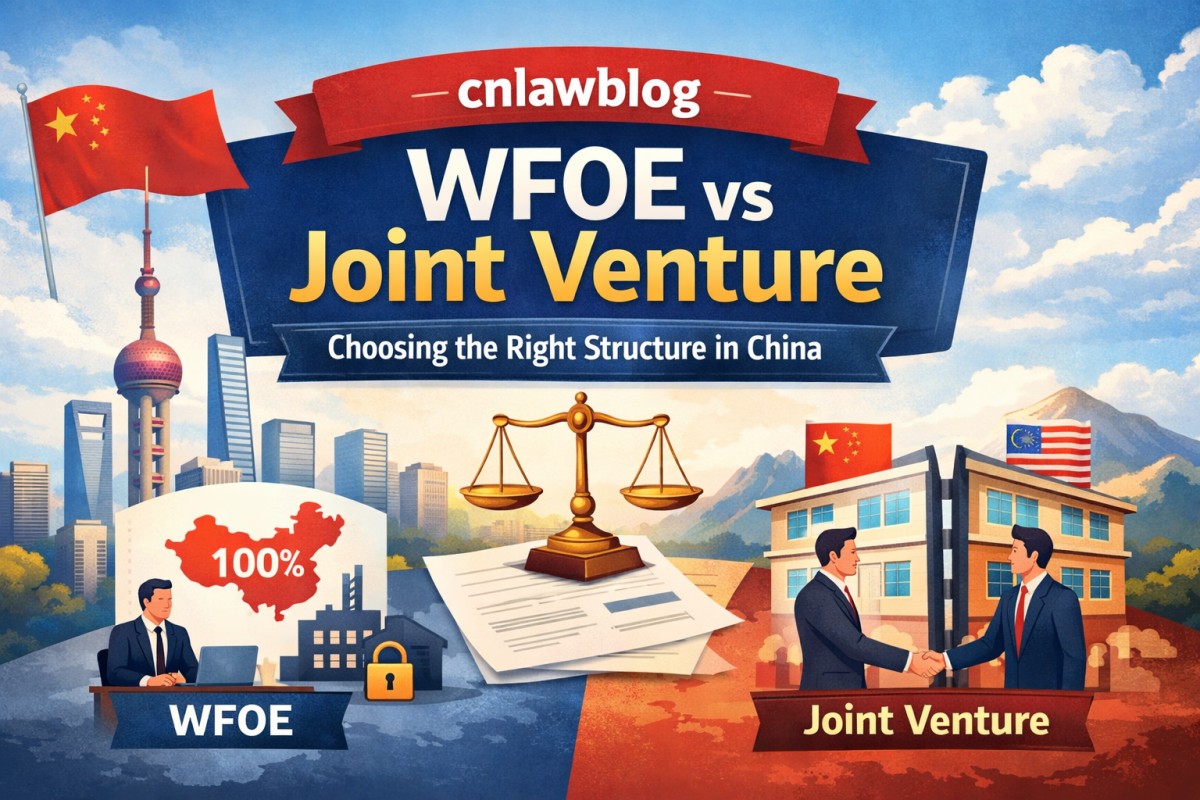
Expanding into China is an exciting milestone for any international entrepreneur. The country offers one of the world’s largest consumer markets, advanced manufacturing ecosystems, strong digital infrastructure, and deep supply chains that are difficult to replicate elsewhere. Yet, success in China doesn’t begin with sales or marketing—it starts with structure.
Before you hire employees, sign contracts, or open a bank account, you must choose the correct legal vehicle under Chinese law. This early decision shapes your level of control, profit distribution, operational flexibility, regulatory exposure, and long-term risk.
At cnlawblog, we frequently see foreign founders rush incorporation without fully understanding their options. The result can be unnecessary disputes, restricted operations, or costly restructuring later. The two most common structures foreign investors evaluate are:
- WFOE (Wholly Foreign-Owned Enterprise)
- Joint Venture (JV)
Both are legally recognized vehicles in China, but they serve very different purposes. This guide explains how each works, compares advantages and risks, and helps you decide which model fits your strategy.
Understanding the Legal Framework Under China Law
A combination of national statutes, administrative rules, and local regulations governs foreign investment in China. Over the past decade, China has simplified foreign investment procedures, but compliance remains strict.
Key considerations include:
- Business scope approvals
- Licensing requirements
- Industry restrictions or “negative list” sectors
- Capital registration
- Tax registration
- Employment compliance
- Intellectual property protection
Choosing the correct structure determines how you satisfy these requirements and how much autonomy you retain over daily operations.
What Is a WFOE?
A WFOE (Wholly Foreign-Owned Enterprise) is a limited liability business owned entirely by foreign investors. There is no Chinese shareholder. The foreign parent or individual owns 100% of the equity.
International companies widely use this structure because it provides maximum control and independence.
Core Characteristics of a WFOE
A WFOE allows you to:
- Maintain full ownership and decision-making authority
- Control management, hiring, and strategy
- Issue invoices (fapiao) directly
- Sign contracts with Chinese customers and suppliers
- Import and export independently
- Protect proprietary technology and IP internally
- Repatriate profits after taxes
For many modern startups, tech firms, consulting companies, and e-commerce businesses, the WFOE has become the default choice.
Advantages of a WFOE
1. Complete Operational Control
Control is often the primary reason entrepreneurs select a WFOE. You make all decisions—pricing, staffing, partnerships, product development—without negotiating with a local shareholder.
There is no risk that strategic disagreement will slow execution.
2. Stronger Intellectual Property Protection
Foreign companies entering China often worry about IP leakage. With a WFOE, your trade secrets, source code, processes, and supplier lists remain internal. There is no partner with automatic access to sensitive information. For tech startups and product companies, this is critical.
3. Easier Profit Distribution
Since you own 100%, profit distribution is straightforward. After paying taxes and statutory reserves, profits can be repatriated to the parent company.
4. Brand Consistency
A WFOE allows you to implement global standards and branding without compromise. You avoid conflicts over marketing direction or local adaptations that may dilute your brand.
5. Cleaner Exit Strategy
Selling or closing a WFOE is generally simpler than dissolving a joint venture. You don’t need partner consent to restructure or exit.
Limitations of a WFOE
Despite its advantages, a WFOE isn’t always ideal.
1. Higher Setup Costs
You bear 100% of incorporation costs, capital requirements, and operating expenses.
2. No Built-in Local Network
Without a Chinese partner, you must independently build relationships with:
- Suppliers
- Regulators
- Distributors
- Local governments
This can slow early growth.
3. Restricted Industries
Certain sectors—such as media, telecom, education, and others—may restrict or prohibit full foreign ownership. In these cases, a WFOE may not be permitted.
What Is a Joint Venture?
A Joint Venture (JV) is a company jointly owned by foreign and Chinese investors. Ownership percentages vary, often 50–50 or 51–49, depending on negotiations and regulatory requirements.
The purpose of a JV is collaboration: combining foreign technology or capital with local knowledge, licenses, and relationships.
Types of Joint Ventures
Equity Joint Venture
Both parties contribute capital and share profits in accordance with their equity percentages.
Cooperative Joint Venture
Profit sharing and responsibilities can be structured more flexibly through contracts.
Advantages of a Joint Venture
1. Faster Market Entry
Local partners often bring:
- Existing licenses
- Distribution networks
- Supplier relationships
- Government connections
This can accelerate approvals and reduce startup time.
2. Shared Risk
Capital requirements and financial exposure are split between partners.
3. Local Expertise
Understanding Chinese business culture, regulations, and negotiation styles takes time. A strong partner helps navigate these complexities.
4. Access to Restricted Sectors
In some industries, a JV is the only legally permitted route for foreign investors.
Risks of a Joint Venture
1. Reduced Control
You cannot make unilateral decisions. Major actions require board or partner approval.
Disagreements can stall progress.
2. IP Exposure
Sharing technology or processes with a partner may create long-term risks, especially if the relationship deteriorates.
3. Profit Sharing
Even if you contribute more value, profits are split according to ownership or contract terms.
4. Exit Complications
Leaving a JV often requires negotiations with partners, asset valuation disputes, and regulatory approvals.
WFOE vs Joint Venture: Side-by-Side Comparison
Control
- WFOE: Full control
- JV: Shared control
Risk
- WFOE: All risk borne by you
- JV: Shared financial risk
Speed
- WFOE: Slower relationship building
- JV: Faster local access
IP Safety
- WFOE: Strong protection
- JV: Higher exposure
Profit
- WFOE: 100% retained
- JV: Shared
Industry Access
- WFOE: Some restrictions
- JV: Better for regulated sectors
How to Choose the Right Structure
Choose a WFOE if:
- You want complete control
- Your business relies heavily on IP
- You operate in consulting, tech, trading, or services
- You prefer independent management
- Your industry allows full foreign ownership
Choose a Joint Venture if:
- Regulations require a Chinese partner
- Local licenses are critical
- Distribution networks are hard to build alone
- You need fast government access
- You trust a strategic local partner
Common Mistakes Foreign Entrepreneurs Make
At cnlawblog, we repeatedly observe avoidable mistakes:
Mistake 1: Choosing a JV purely for convenience
Speed today can mean disputes tomorrow.
Mistake 2: Ignoring the business scope
If your registered scope is too narrow, you can’t legally invoice for certain activities.
Mistake 3: Weak contracts
Poorly drafted agreements lead to partner conflicts.
Mistake 4: Underestimating compliance
Tax, labor, and reporting rules are strict and ongoing.
Practical Tips from cnlawblog
Before deciding, take these steps:
- Conduct legal due diligence on industry restrictions
- Evaluate your need for control vs local support
- Assess IP sensitivity
- Review capital requirements
- Draft detailed shareholder or JV agreements
- Consult experienced Chinese legal counsel
Early planning prevents costly restructuring later.
Frequently Asked Questions (FAQs)
1. What is the main difference between a WFOE and a Joint Venture in China?
The key difference is ownership and control. A WFOE is 100% owned by foreign investors, giving you full control over operations and profits. A Joint Venture involves both foreign and Chinese partners, meaning ownership, decision-making, and profits are shared.
If control and independence are priorities, a WFOE is typically preferred. If local access and regulatory support are essential, a Joint Venture may be a better option.
2. Can foreigners own 100% of a company in China?
Yes, in many industries, foreign investors can fully own their companies through a WFOE under Chinese law. However, certain sectors—such as media, education, telecommunications, and sensitive technologies—may restrict or prohibit full foreign ownership. Always check whether your industry appears on China’s negative list before incorporation.
3. Is a WFOE better than a Joint Venture?
Not necessarily. It depends on your business goals.
A WFOE is better if you want:
- Full control
- Strong IP protection
- Independent management
- 100% profit retention
A Joint Venture may be better if you need:
- Local licenses or approvals
- Government connections
- Distribution networks
- Access to restricted sectors
The “better” option depends on strategy, not just structure.
4. How long does it take to set up a WFOE in China?
Typically, WFOE registration takes around 2–4 months, depending on:
- Industry approvals
- City of registration
- Business scope complexity
- Banking and licensing requirements
Delays often occur if documents are incomplete or if the business scope requires special permits.
5. Is a Joint Venture faster to launch than a WFOE?
Sometimes. If your Chinese partner already holds the necessary licenses, facilities, or government approvals, market entry can be quicker. However, negotiating and drafting JV agreements may take longer than expected. The timeline varies case by case.
6. Which structure offers better intellectual property protection?
A WFOE generally provides stronger IP protection because you do not share ownership or proprietary information with a partner. In a Joint Venture, technology transfer and shared access may increase the risk of IP disputes or leaks.
Companies with sensitive technology often prefer WFOEs.
7. Do WFOEs need registered capital in China?
Yes. While China has removed strict minimum capital requirements for many industries, you must still declare registered capital based on your business needs. Authorities expect the amount to realistically support operations, such as rent, salaries, and working capital.
Underestimating capital can create operational problems later.
8. Can a WFOE hire employees directly in China?
Yes. A WFOE can hire local and foreign employees, sign labor contracts, and manage payroll directly. However, it must comply with Chinese labor laws, social insurance contributions, and employment regulations.
Labor compliance is strictly enforced.
9. How are profits distributed in a WFOE?
After paying corporate taxes and setting aside statutory reserves, remaining profits can be repatriated to the foreign parent company. Since you own 100%, there is no need for profit sharing.
This is one of the main financial advantages of a WFOE.
10. How are profits shared in a Joint Venture?
Profits are usually distributed according to ownership percentages or contractual arrangements. For example, if you own 60% and your partner owns 40%, profits are split accordingly unless otherwise agreed in the JV contract.
11. Can I convert a Joint Venture into a WFOE later?
It is possible, but complex. You may need:
- Partner buyout agreements
- Asset valuation
- Regulatory approvals
- Corporate restructuring
Conversion can be costly and time-consuming. Choosing the correct structure from the beginning is more efficient.
12. What industries commonly use WFOEs?
WFOEs are popular in:
- Consulting
- Trading and sourcing
- Technology and SaaS
- E-commerce
- Manufacturing
- Professional services
These sectors typically allow full foreign ownership and benefit from operational control.
13. When is a Joint Venture legally required?
Some regulated industries require Chinese participation. Examples may include:
- Media and broadcasting
- Education services
- Certain telecom services
- Sensitive infrastructure
In these cases, a Joint Venture may be the only legal route under Chinese law.
14. What risks should I consider before entering a Joint Venture?
Common risks include:
- Partner disputes
- Loss of management control
- IP exposure
- Cultural or strategic differences
- Difficulty exiting
Careful due diligence and detailed contracts are essential.
15. Can a WFOE issue invoices (fapiao) in China?
Yes. Once registered for tax and invoicing, a WFOE can issue official invoices (fapiao) to customers, which are required for legal transactions and tax deductions in China.
16. Which structure is easier to close or exit?
A WFOE is generally easier to close because no partner approval is required. A Joint Venture often involves negotiation with the Chinese shareholder and more complex legal procedures.
17. Do I need a Chinese partner to succeed in China?
Not always. Many foreign companies operate successfully through WFOEs by building their own networks. However, in industries that rely heavily on government relationships or local distribution, partnerships can be beneficial.
18. What documents are required to establish a WFOE?
Typical documents include:
- Parent company registration documents
- Investor identification
- Business plan
- Office lease agreement
- Articles of association
- Proposed business scope
Requirements may vary by city.
19. How can cnlawblog help foreign entrepreneurs?
cnlawblog provides practical guidance on:
- Choosing between WFOE and Joint Venture
- Company registration steps
- Compliance requirements
- Contracts and IP protection
- Ongoing legal updates related to Chinese law
It aims to simplify complex regulations for global founders entering the Chinese market.
20. What is the most important step before choosing a structure?
Conduct legal and strategic planning. Evaluate your:
- Industry restrictions
- Control requirements
- Capital capacity
- IP sensitivity
- Long-term exit strategy
Making the right decision early can save years of complications later.
Final Thoughts
There is no universal answer to the WFOE vs Joint Venture debate. The right structure depends on your industry, strategy, risk tolerance, and long-term goals.
If independence, IP protection, and control matter most, a WFOE is often the better path. If regulations or market realities demand local collaboration, a carefully structured Joint Venture may provide the advantage you need.
Entering China is a strategic move that can unlock enormous opportunities. But the foundation must be legally sound. Structure first. Expand the second.
Source links:
📄 Sources on WFOE (Wholly Foreign-Owned Enterprise)
🔗 Everything You Need to Know About WFOE in China (Air Corporate) – Overview of what a WFOE is, ownership, permitted activities, and key differences with other structures. Air Corporate – A Guide to WFOE in China
🔗 The Chinese WFOE and its most important corporate bodies (Lorenz & Partners) – Explains WFOE’s legal status, foreign ownership, and how China’s Foreign Investment Law governs them. Lorenz & Partners – WFOE Legal Overview
🔗 Company Formation Options in China (YB Case) – Basic definition and features of a WFOE, including liability and scope of activities. YB Case – Wholly Foreign‑Owned Enterprise Explained
🔗 Incorporation in China | GDL Global – Practical summary of what a WFOE is, its benefits, and key considerations. GDL Global on WFOE vs JV in China
📄 Sources on Joint Ventures and Comparison with WFOE
🔗 The Difference Between a WFOE and a Joint Venture (Azure Group China) – Side-by-side comparison of ownership, control, IP protection, market access, profit sharing, and speed of setup for WFOE vs JV. Azure Group China – WFOE vs JV Comparison
🔗 China Joint Ventures: Everything You Should Know (Mondaq) – Insights into JV structures and considerations when partnering with local entities under Chinese law. Mondaq – China Joint Ventures Guide
🔗 Foreign Investment in China: An Introduction (JDSupra) – Includes context on Cooperative Joint Ventures (CJVs) and how they differ from Equity JVs and WFOEs. JDSupra – Foreign Investment in China Overview